

DogLCD Library
DogLCD lets you use the DOG-M LCDs from Electronic Assembly. Only 4 pins are used.
| Download: |
Included with the Teensyduino Installer |
LiquidCrystal works perfectly with Teensy 2.0 and Teensy++ 2.0 and Teensy 3.0.
Hardware Requirements
The EADOGM081, EADOGM162, and EADOGM163 are supported. This photo shows a EADOGM162S-A with EALED55x31-A backlight.
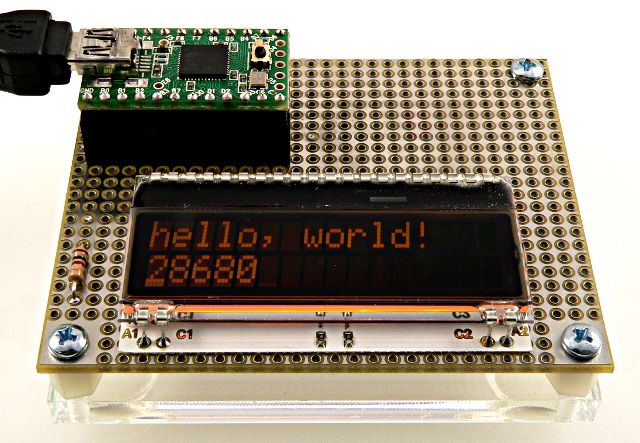
DogLcd works on Teensy 2.0 and Teensy++ 2.0 and Teensy 3.0. The DogM
displays are able to receive 3.3 volt signals, even when running at
5 volts.
Basic Usage
LiquidCrystal lcd(SI, CLK, RS, CSB)Create the DogLcd object and specify the 4 pins where the LCD is connected. You can connect more than one LCD and create separate DogLcd objects for each.
lcd.begin(type);Initialize the display. Type should be DOG_LCD_M081, DOG_LCD_M162, or DOG_LCD_M163.
lcd.print(anything);Print a number or text. This works the same as Serial.print(), but prints to the LCD.
lcd.setCursor(x, y);Move the cursor to position (x, y). These are zero-based coordinates.
Many other functions are available. See below for links to more details.Example Program
This example can be loaded with File > Examples > DogLcd > HelloWorld./* DogLcd Library - Hello World Demonstrates the basic use of a DOGM text LCD display. This sketch prints "Hello World!" to the LCD and shows the time. See the online-documention for wiring instuctions We assume the following pins are connected: * LCD SI pin to digital pin 2 * LCD CLK pin to digital pin 3 * LCD RS pin to digital pin 4 * LCD CSB pin to digital pin 5 * LCD RESET pin is not used * LCD Backlight pin is not used http://www.arduino.cc/en/Tutorial/LiquidCrystal */ // include the library code: #include <DogLcd.h> // initialize the library with the numbers of the interface pins DogLcd lcd(2, 3, 4, 5); void setup() { // set up the LCD type and the contrast setting for the display lcd.begin(DOG_LCD_M162); // Print a message to the LCD. lcd.print("hello, world!"); } void loop() { // set the cursor to column 0, line 1 // (note: line 1 is the second row, since counting begins with 0): lcd.setCursor(0, 1); // print the number of seconds since reset: lcd.print(millis()/1000); }
Teensy 3.0 Usage
For use with Teensy 3.0, the DogM LCD can be run at 5 volts. It is able to accept the 3.3 volt signals from Teensy 3.0. Because all 4 signals are unidirectional from Teensy 3.0 to the LCD, there is no issue with 5 volt signals driving 3.3 volt only inputs.

Details
For more details, please refer to the official DogLcd library page and the DOG-M LCD page.The display and backlight shown in the photo were purchased from Mouser Electronics.